
When It’s Worth Travelling to a Specialist Chiropractor Instead of Going Local
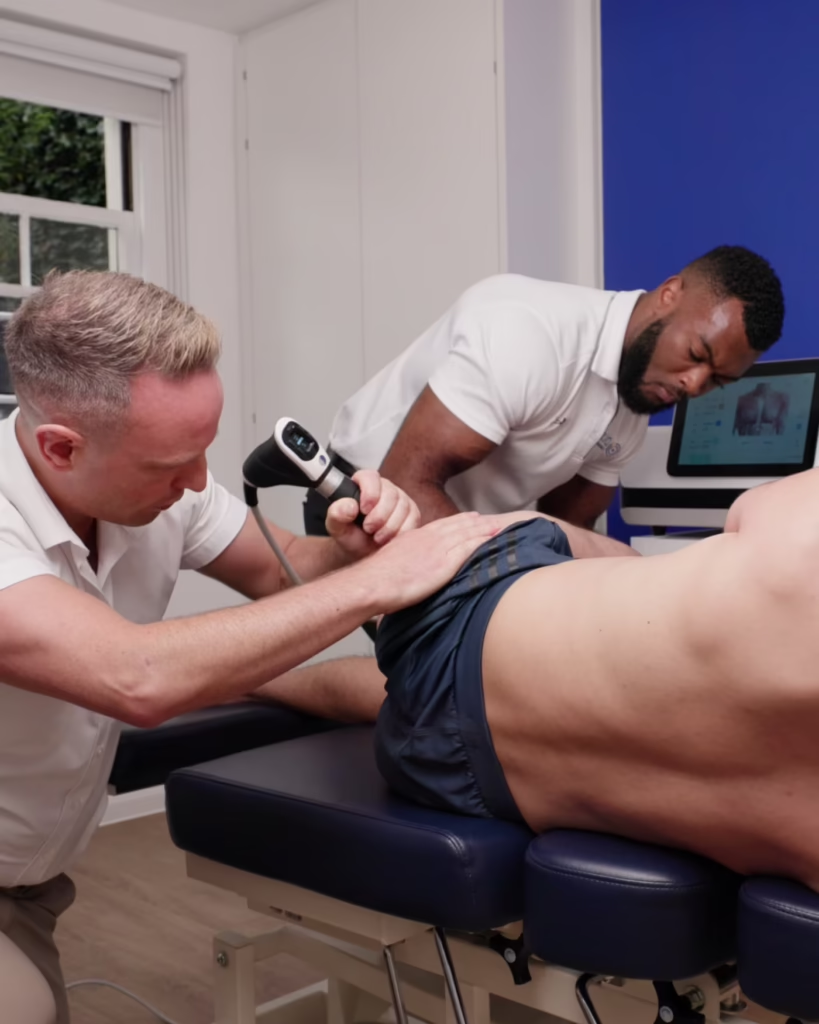
Most people search for a chiropractor nearby when pain strikes; convenience matters. But for more complex conditions, particularly those involving spinal discs, persistent nerve pain, or neurological symptoms, prioritising specialist expertise over simple proximity may sometimes lead to a more appropriate rehabilitation pathway and better long-term management outcomes. [20][79]
In this guide, we’ll explore:
- Why local care is often the default, and when it may be sufficient
- The signs your condition may require specialist intervention
- What differentiates a specialist clinic from a generalist practice
- How to weigh travel convenience against treatment structure and expertise
- Why some patients choose to travel to The DISC Chiropractors for care
Let’s begin by examining the assumptions behind the idea that “local automatically means better.”
Why People Default to Local Chiropractors
It’s easy to see why most people start their search with a location-based query like “chiropractor near me.” When you’re in pain, you typically want help quickly, ideally somewhere easy to access without major disruption to your daily routine.
Local chiropractic care can be more than appropriate for many general musculoskeletal complaints, including postural tightness, mild lower back pain, simple neck strain, or short-term mobility restrictions. Many chiropractors provide effective conservative care that helps reduce discomfort, improve movement, and support short-term symptom management. [18][88]
Consider Sarah, a busy corporate professional who experiences occasional neck strain after long hours at her desk. A nearby lunchtime appointment with her local chiropractor helps relieve tension and restore movement, allowing her to return to work more comfortably. For straightforward musculoskeletal complaints, this convenience and accessibility can make local care a highly practical option.
Local care also offers several logistical advantages. Shorter travel times can make it easier to book appointments quickly during acute flare-ups or periods of increased discomfort. For busy patients, being able to attend treatment between work commitments or family responsibilities can improve consistency and reduce barriers to care.
Consistency itself is another important factor. When treatment is nearby, patients are often better able to maintain regular appointments, which may support rehabilitation adherence, ongoing reassessment, and continuity of care in milder or more manageable musculoskeletal cases. [80][86]
Local clinics can also provide valuable reactive support. If symptoms unexpectedly worsen, it is often easier to arrange a prompt reassessment or short follow-up appointment when the clinic is located nearby. This accessibility can be particularly useful for routine maintenance care or short-term symptom flare management.
However, these advantages may become less significant when the condition itself is more complex, persistent, or less responsive to standard conservative approaches. This can particularly apply in cases involving disc pathology, persistent nerve irritation, recurrent sciatica, or more advanced mechanical spinal dysfunction. In these situations, some patients may benefit from more structured assessment, staged rehabilitation planning, or specialist conservative management approaches beyond standard short-format manual treatment alone. [1][42]
Disc-related pain is also extremely common within musculoskeletal practice and chronic low back pain populations, although the severity, presentation, and treatment needs vary considerably between patients. Persistent discogenic symptoms may sometimes require a more carefully sequenced rehabilitation strategy than standard reactive symptom-management approaches alone. [67][68]
Local Chiropractic: Quick Snapshot
Proximity | Easy to reach, fits within daily schedule |
Fast Access | Can often book on short notice |
Convenience | Useful for maintenance care and straightforward musculoskeletal complaints |
Continuity | Easier to maintain regular attendance and follow-up |
Limitations | More complex disc or nerve-related cases may sometimes require more specialised assessment or rehabilitation approaches |
What Makes a Chiropractic Specialist Different?
A specialist chiropractor typically develops advanced experience in managing specific patient groups, conditions, or rehabilitation approaches beyond broad general musculoskeletal care. This may involve additional postgraduate training, years of focused clinical experience, structured rehabilitation systems, and specialised assessment tools or technologies tailored to particular presentations. [20][79]
- Focused Expertise
While many chiropractors treat a broad range of musculoskeletal complaints, some practitioners choose to focus more heavily on specific patient populations, conditions, or rehabilitation models. Chiropractic specialisation can span areas such as sports rehabilitation, paediatric care, pregnancy-related musculoskeletal management, chronic pain, or complex spinal rehabilitation pathways.
For example, sports-focused chiropractors may work closely with athletes to support injury prevention, recovery, and movement efficiency. Chiropractors working with paediatric populations require different examination procedures, communication strategies, and safety considerations appropriate for younger patients. Others may focus on prenatal or postnatal musculoskeletal care, while some develop greater experience managing mobility limitations, balance issues, and degenerative joint conditions in older adults. [20][88]
At The DISC Chiropractor, our primary clinical focus is on disc injuries, nerve irritation, sciatica, and more complex spinal presentations that may require a more structured rehabilitation approach than routine short-format manual treatment alone. This level of clinical concentration allows us to refine assessment procedures, rehabilitation sequencing, and multimodal treatment strategies specifically around these higher-sensitivity cases. [1][79]
- Bespoke Treatment Planning
As specialists, we use detailed assessment findings, symptom behaviour, imaging where clinically appropriate, movement tolerance, neurological presentation, and patient goals to help tailor rehabilitation plans more precisely for complex disc and nerve-related conditions. Rather than applying a single standardised approach, care progresses through structured phases that may include symptom reduction, movement restoration, stabilisation, and longer-term rehabilitation planning. [83][88]
Thanks to our specialist clinical focus and internal case-tracking systems, we are often able to discuss likely recovery trajectories with greater confidence, informed by previous patients with similar presentations. For example, in some cases, we may estimate that a patient with a particular clinical profile has a higher probability of achieving a meaningful functional improvement within a projected timeframe, although individual outcomes always vary depending on severity, chronicity, adherence, lifestyle factors, and response to treatment. [80][98]
An “80% improvement” may mean different things for different patients. For one person, it could mean returning to walking comfortably for 30 minutes. For another, it may involve sitting through a workday, sleeping more consistently, or returning to exercise with significantly less pain. These projected milestones are based on internal clinical audit data, published rehabilitation principles, and experience managing similar presentations over time, rather than guarantees of outcome. [79][88]
This level of structured monitoring also allows us to regularly reassess progress and adapt treatment strategies as needed. If recovery is not progressing as expected, care plans can be modified, diagnostics revisited, or external referral pathways considered where clinically appropriate. This helps patients develop more realistic expectations while reducing the need for prolonged trial-and-error. [20]
- Access to Advanced Technology
At The DISC Chiropractor in Surbiton, our rehabilitation approach may incorporate a range of advanced technologies depending on the patient’s presentation and stage of recovery:
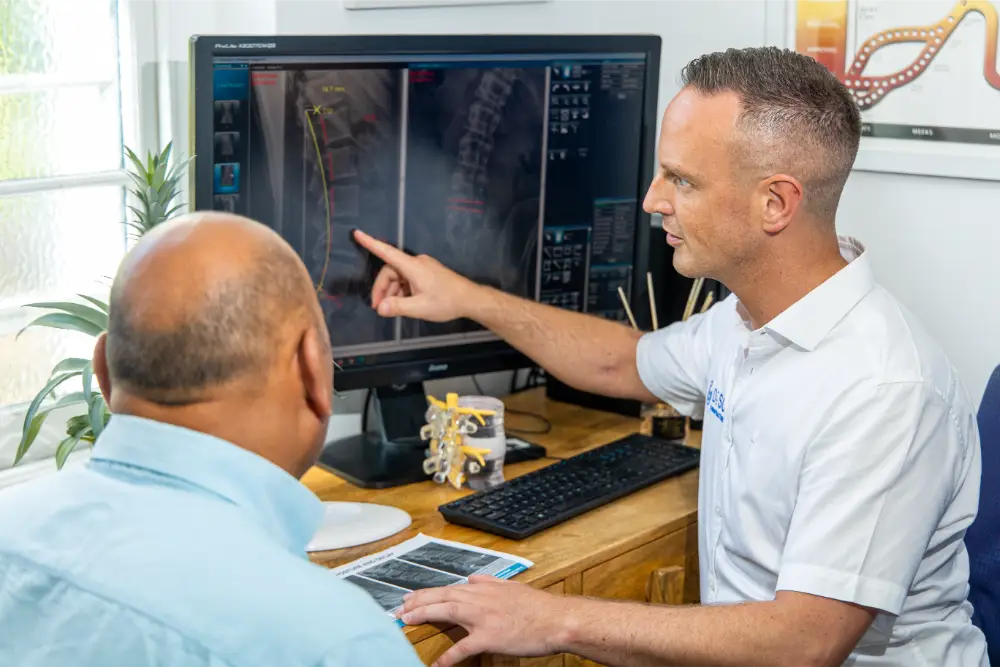
- In-house digital X-rays to support immediate assessment and diagnostic clarification where clinically appropriate
- Spinal decompression systems designed to reduce mechanical loading on affected spinal structures
- Class IV laser therapy used to support tissue healing responses and pain reduction
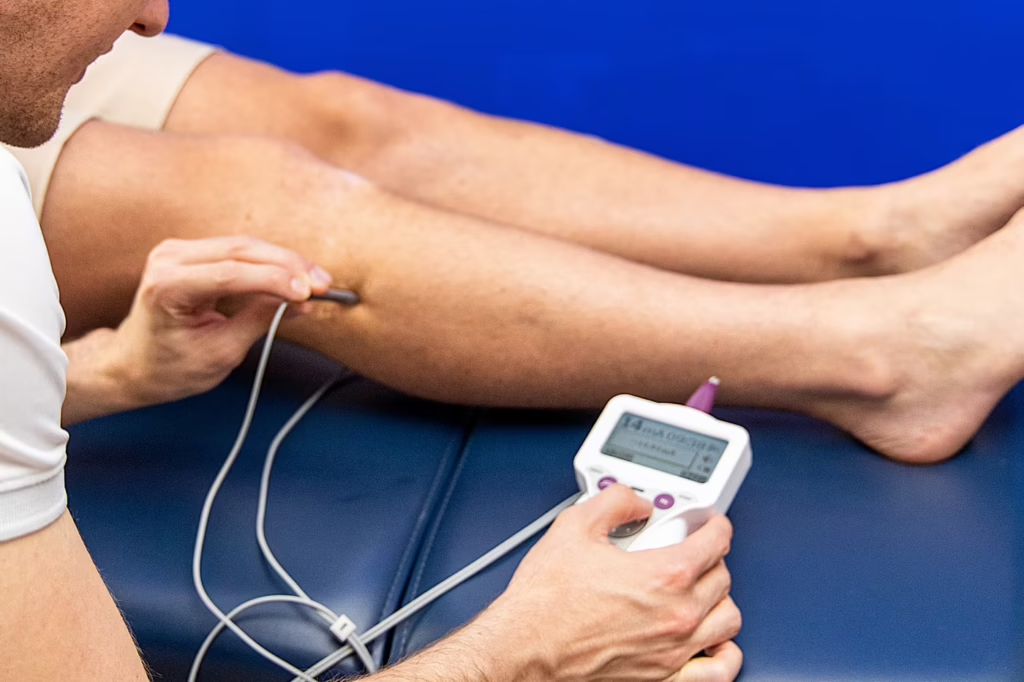
- Neuromuscular stimulation strategies aimed at improving muscular activation and movement control
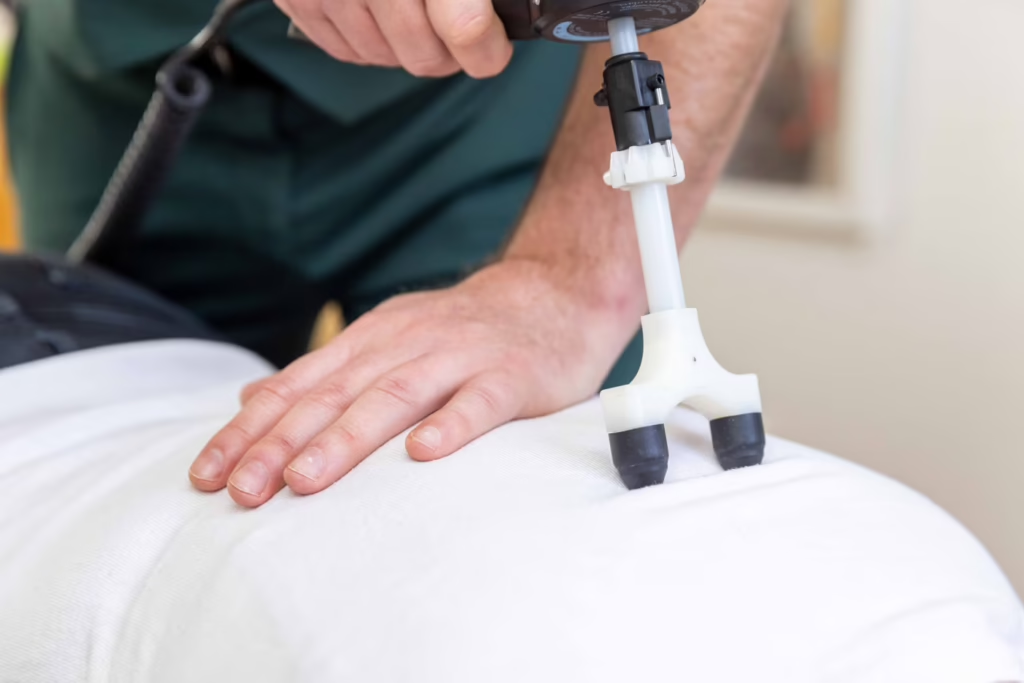
- Instrument-assisted adjustments that allow lower-force treatment approaches for more sensitive patients
- HIEMT-based rehabilitative magnetic stimulation for patients struggling with muscular engagement and spinal stability
- Pressure-Wave therapy using acoustic shockwave technology to support tissue mobility and rehabilitation tolerance
These technologies are not used as standalone “quick fixes,” but rather as part of a broader structured rehabilitation framework designed around patient tolerance, progression, safety, and long-term functional recovery. In complex or persistent cases, integrating multiple conservative strategies may improve treatment precision and rehabilitation efficiency compared with relying on a single modality. [42][45][49][50][72]
- More Conservative and Sequenced Care
Rather than immediately introducing higher-force manual adjustments, which in some cases may aggravate highly sensitive disc or nerve presentations if applied too early or too aggressively, we take a more sequenced and carefully staged approach to care. Our conservative rehabilitation process often begins with lower-force interventions such as Class IV laser therapy and instrument-assisted adjusting, aiming to reduce pain sensitivity, improve treatment tolerance, and help calm irritated tissues before progressing further. [45][72]
Once sufficient symptom reduction and movement tolerance have been achieved, we may then introduce spinal decompression therapy as part of the active rehabilitation phase. The aim is to reduce mechanical loading on affected spinal structures and support more gradual recovery progression before considering more traditional manual techniques, where clinically appropriate. Manual therapy, if used, is introduced progressively based on patient response, irritability levels, and overall functional improvement rather than as a one-size-fits-all starting point. [42][79]
This staged rehabilitation strategy is built around both safety and progression. By adapting interventions according to the patient’s presentation, recovery rate, and symptom sensitivity, we aim to reduce unnecessary flare-ups whilst helping patients progress toward more active rehabilitation as comfortably and efficiently as possible. Patients are also assessed individually for treatment tolerance, risk factors, and overall rehabilitation goals so that care remains progressive without becoming unnecessarily aggressive. [20][88]
This methodology has evolved over years of experience managing patients with persistent disc injuries, nerve irritation, chronic pain, and cases that may not have responded well to previously used more generalised treatment approaches. The emphasis is not on avoiding manual care entirely, but on introducing the right intervention at the right stage of recovery. [1][79]
Comparing Specialist vs Generalist Clinics
So, how do you know when it may be worth looking beyond your local high street clinic?
The key question is whether there is anything particularly complex, persistent, or unique about your presentation. In some patient groups, such as elite athletes, pregnant women, infants, or patients with significant neurological symptoms, the need for more specialist experience may become more obvious from the outset.
Factor | Generalist Chiropractor | Specialist Clinic – Disc Injuries |
Focus | Broad musculoskeletal complaints | Disc, nerve, and complex spinal rehabilitation |
Plan Type | General symptom-management approach | Structured milestone-based rehabilitation |
Clinical Emphasis | Broad musculoskeletal management | Greater focus on complex-case assessment and progression |
Technology | May vary between clinics | Integrated diagnostics and rehabilitation technologies |
Assessment | Standard orthopaedic and movement testing | Imaging, neurological screening, and functional reassessment, where appropriate |
Philosophy | Often adjustment-focused | Multi-modal and rehabilitation-led |
So, how do you know when it may be worth looking beyond your local high street clinic?
In disc-related conditions, however, the signs can sometimes appear subtler and may initially resemble routine back or neck pain. This is why it can be important to look beyond simple symptom relief and consider factors such as nerve involvement, symptom progression, functional decline, and your body’s response to previous treatment approaches. [1][67]
Symptoms You Should Not Ignore
If you answer “yes” to one or more of the following, it may be worth seeking a more specialist assessment:
- Radiating symptoms such as pain travelling into the arms or legs, numbness, tingling, or weakness
- More advanced neurological symptoms, including foot drop, grip weakness, altered reflexes, or burning nerve pain
- Confirmed or suspected disc involvement, including disc bulges or herniations
- Chronic or recurring symptoms persisting for several months
- Symptoms that have failed to improve despite previous conservative treatment
- Significant flare-ups or worsening symptoms following previous treatment approaches
These situations may require more detailed assessment, rehabilitation planning, imaging considerations, or staged conservative management strategies than those for simpler musculoskeletal complaints. Early recognition of nerve involvement, persistent disc-related symptoms, or poor treatment tolerance may help reduce prolonged ineffective treatment cycles and support more appropriate rehabilitation planning. [18][83]
Key Indicators Summary
Symptom | Why It Matters |
Radiating Pain | May suggest nerve root irritation or disc involvement |
Chronic Recurring Symptoms | May indicate unresolved biomechanical or rehabilitation issues |
Significant Post-Treatment Flare-Ups | May indicate increased tissue sensitivity or poor treatment tolerance |
Confirmed Disc Pathology | May require more structured rehabilitation and loading strategies |
Neurological Symptoms | May require a more detailed neurological assessment and monitoring |
Travel vs Local: The True Comparison
It’s easy to view travelling for care as an inconvenience, especially when local options appear faster and more accessible. However, when symptoms are complex, persistent, or unresolved, it can be helpful to reframe the question from “What’s closest?” to “What type of care is most appropriate for my situation?” In many areas of healthcare, patients are willing to travel further when they believe a clinician offers more specialised expertise, greater continuity of care, or a more structured rehabilitation approach. [125][126]
Would you choose the nearest dentist if you knew your case required a specialist in complex root canal treatment? Would you automatically choose the nearest mechanic if the issue involved highly specialised electrical diagnostics? In more complex musculoskeletal cases, patients sometimes apply similar reasoning when deciding whether specialist rehabilitation expertise may justify additional travel.
For some patients, travelling further for fewer, more targeted appointments may ultimately feel more efficient than remaining within repeated cycles of short-term symptom management without meaningful long-term progression. This can be particularly relevant for persistent disc-related conditions, recurrent nerve irritation, or cases that have not responded well to previous conservative treatments. [79][88]
Travel vs Local Care Snapshot
Category | Local Chiropractor | Specialist Clinic (DISC) |
Travel Time | Short and convenient | Longer travel but potentially fewer overall visits |
Diagnostic Depth | Standard clinical assessment | More extensive imaging, neurological, and functional assessment, where appropriate |
Treatment Approach | Often manual therapy focused | Sequenced multi-modal rehabilitation approach |
Risk Management | General musculoskeletal management | Greater emphasis on staged progression and treatment tolerance |
Rehabilitation Structure | Variable between clinics | Structured milestone-based rehabilitation planning |
A short-term commitment to travelling for more specialised assessment or rehabilitation may, in some cases, help patients avoid prolonged cycles of ineffective treatment, delayed diagnosis, or repeated symptom flare-ups. [1][20]
At The DISC Chiropractor in Surbiton, we generally recommend keeping routine travel times manageable, ideally around 1 hour, for ongoing care. However, some patients choose to travel further when specific technologies or rehabilitation approaches are unavailable closer to home. In our internal clinic audit data, many long-distance patients successfully complete structured treatment plans through flexible scheduling, clustered appointments, and carefully planned rehabilitation timelines. [80]
To support patients travelling from further afield, we have developed travel-friendly rehabilitation options that may include flexible scheduling, clustered appointments, or short-term intensive care blocks, depending on the individual case. Many travelling patients choose to combine multiple appointments into a single visit to minimise disruption whilst maintaining continuity of care. [126]
Real Patient Example: Why People Travel to The DISC Chiropractors
Meet John, a 42-year-old architect with a passion for outdoor activities. Despite leading an active lifestyle, he developed persistent lower back pain that had continued for over a year. He initially received care locally and experienced short-term symptom relief, but his overall progress plateaued, and his symptoms continued recurring.
After researching more specialist options, John contacted The DISC Chiropractors because of our specific focus on disc-related conditions and structured rehabilitation approach. Following a detailed assessment and imaging review, where clinically appropriate, his presentation was identified as consistent with a significant disc-related injury requiring a more carefully staged rehabilitation plan. [83]
Rather than immediately progressing into more forceful manual treatment, care initially focused on reducing symptom sensitivity and improving treatment tolerance through lower-force interventions, including Class IV laser therapy and progressive decompression-based rehabilitation strategies. Treatment was adjusted regularly based on his symptom response, functional progression, and overall tolerance. [42][45][79]
Over time, John reported meaningful improvements in mobility, walking tolerance, and day-to-day comfort levels. As his condition became more stable, rehabilitation progressed toward strengthening, restoring movement, and developing long-term self-management strategies. Based on our internal outcome-tracking systems, his functional improvement ultimately exceeded 80% relative to his initial presentation, although individual outcomes naturally vary among patients. [98]
For John, travelling slightly further for more structured rehabilitation and ongoing reassessment ultimately felt more worthwhile than continuing repeated short-term symptom-management approaches closer to home.
Final Thoughts: Choose Based on Outcomes, Not Postcode
Ultimately, the decision to seek specialist chiropractic care, particularly if it involves travelling further from home, comes down to one key question: Are you making meaningful progress toward the outcome you actually want?
Many patients remain stuck in repeated cycles of short-term symptom relief, inconsistent rehabilitation, or unresolved flare-ups simply because convenience becomes the primary deciding factor when choosing care. However, when it comes to persistent spinal pain, nerve irritation, or complex musculoskeletal problems, factors such as clinical expertise, rehabilitation structure, continuity of care, and accurate assessment may become far more important than postcode alone. [125][126]
At The DISC Chiropractors, our approach is built around detailed assessment, structured rehabilitation planning, ongoing reassessment, and personalised progression strategies designed to support meaningful functional improvement over time. Whether a patient lives five minutes away or travels several hours, our focus remains the same: reducing pain where possible, improving movement and function, and helping patients regain greater confidence and independence in daily life. [79][88][98]
For patients dealing with more complex, persistent, or previously unresolved conditions, specialist conservative rehabilitation may sometimes provide a more appropriate pathway than repeatedly cycling through short-term reactive treatment approaches alone. [1][18]
If you’re unsure whether specialist care is appropriate for your situation, we invite you to book a complimentary discovery call. During this conversation, one of our chiropractors will discuss your symptoms, previous treatment history, and any relevant scans or reports you may already have. The aim is simply to help you better understand your options and whether our approach may be a suitable fit for your case.