
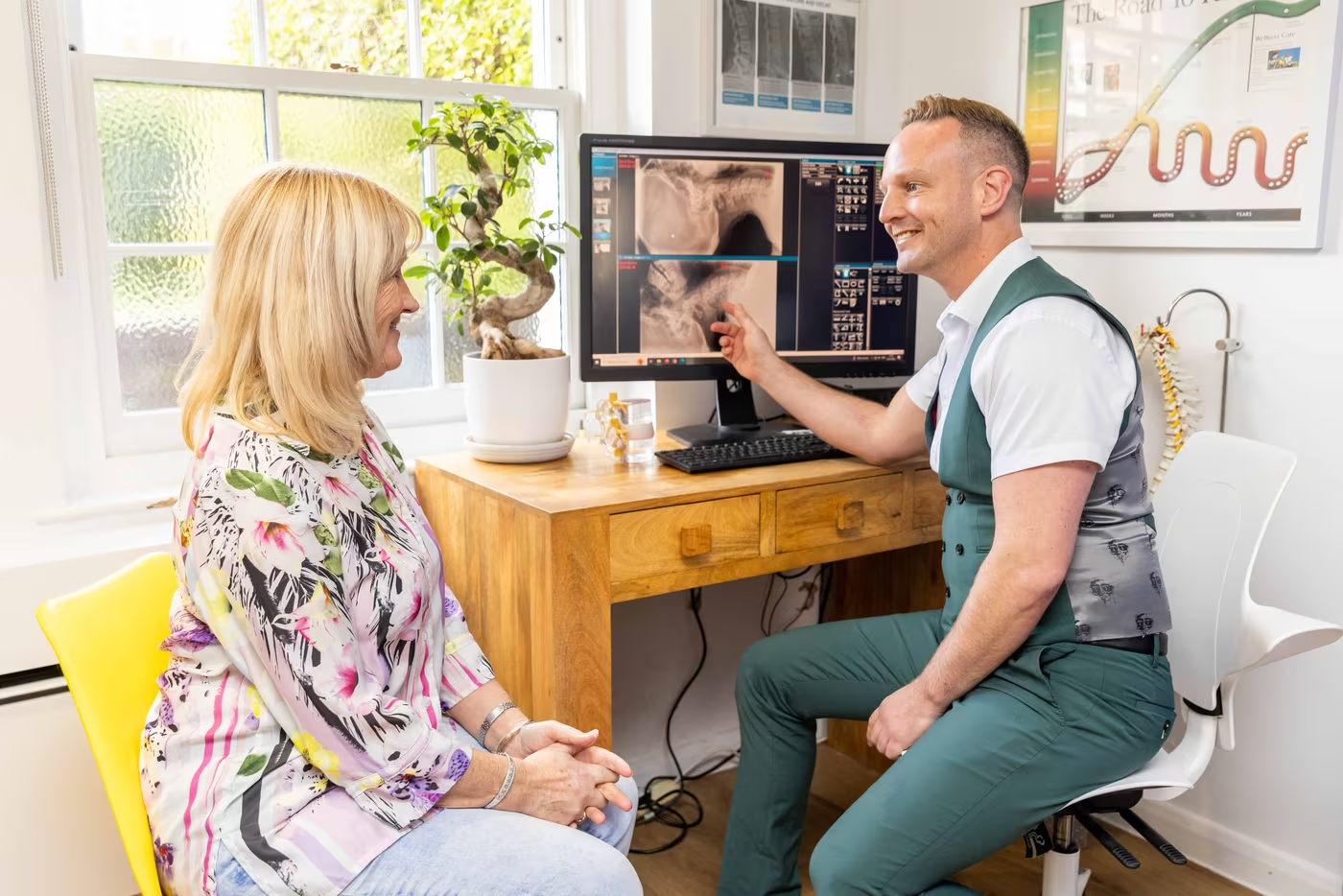
Degenerative Disc Disease Treatment
Most people meet this diagnosis on a piece of paper. A scan report comes back saying degeneration, degenerative disc disease, disc desiccation, loss of disc height, spondylosis, or simply “wear and tear”. Nobody has much time to explain it, so the words do the explaining instead.
Four questions usually follow, in this order. Is my spine wearing out? Is this what is causing my pain? Is it going to keep getting worse? What can I do to stop DDD?
And rather than regurgitate the science behind degenerative disc disease too deeply, we will look to answer these questions in an honest and simple manner.
The main issue is that clinicians of all varieties continue to debate the importance of DDD findings on MRI or X-ray scans. Some argue that degeneration is simply a sign of ageing, like wrinkles on your skin, and nothing to be concerned about. They overlook the fact that this dismisses the pain the patient is experiencing.
The other side of the argument is one of relevancy: does the location of the pain pattern match the location of the degenerative findings, which means they are most likely to be relevant, even if the exact mechanism is poorly understood.
And the reason behind this is that degenerative findings are extremely common in people with no back pain at all. And whilst they are more prevalent in cases with back pain, many believe that if some degenerative discs are pain-free, all must be pain-free. Medicine, however, has many instances where this is not true… some people have stomach ulcers or tooth infections and are completely pain-free; that doesn’t mean all versions of these can’t hurt.
That is what this page is about. We aim to follow research and published evidence wherever possible, but sometimes current knowledge doesn’t match what we repeatedly see in clinical practice. When the two point in different directions, as with DDD, we say so.
Fun Fact
Degenerative changes don’t necessarily hurt!
They are susceptible to external factors that change the amount of inflammation and therefore pain, for example some people are badly affected by poor weather, conversely many find keeping mobile gives great relief.
What does degenerative disc disease mean?
It is a poor name, because it describes neither a disease nor a single condition. It describes a set of changes in a disc’s structure.
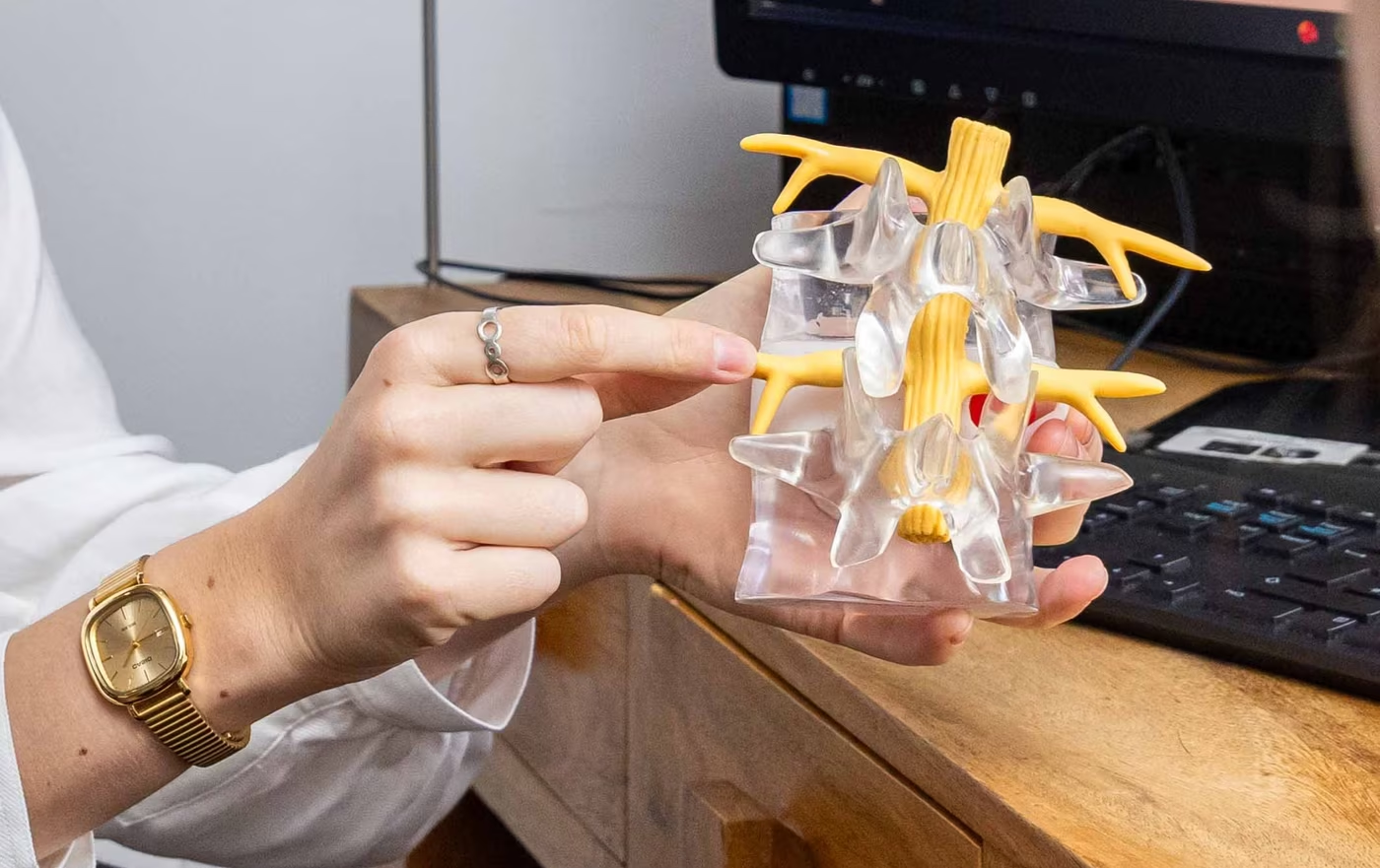
A healthy disc is a pressurised joint rather than a cushion: a fibrous outer wall wrapped around a water-rich gel centre, working because that centre holds pressure. As a disc ages, it holds less water, the gel becomes more fibrous, and the boundary between centre and wall becomes less distinct. Disc height reduces. The disc becomes less springy and distributes load less evenly than it did.
Discs also have almost no blood supply of their own, depending instead on fluid exchange through the bone above and below. That is why discs are prone to slow-moving degenerative changes, and why what you do day to day with your back matters.
None of that is a disease, and almost every adult spine shows some of it. The key is always relevance.
What the scan shows, and what it cannot tell you
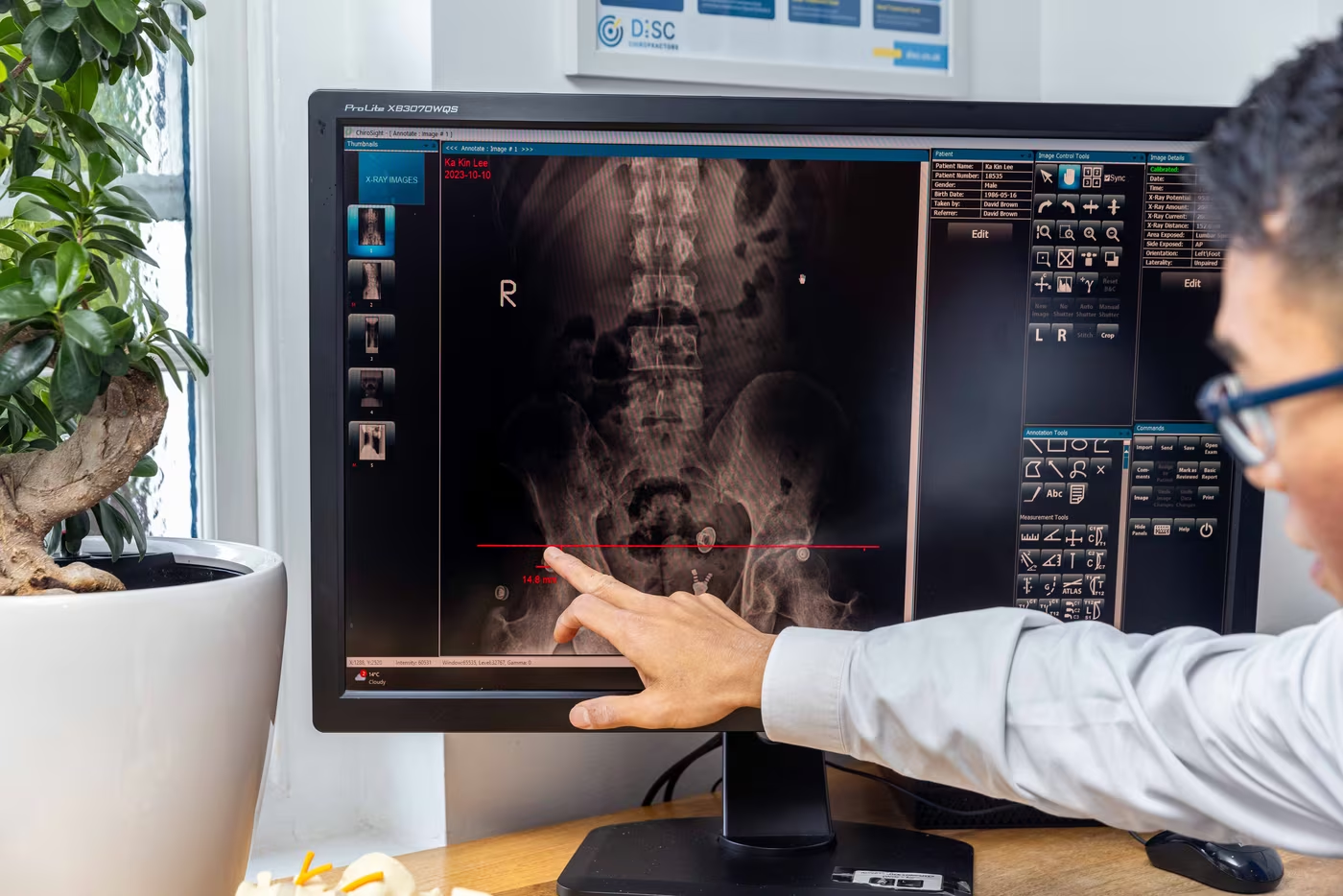
MRI is very good at showing structural change in a disc, although standard X-ray can also identify loss of height as a clear marker of degenerative change. The limitation is not resolution or image quality. The limitation is interpretation.
A useful starting point is understanding just how common these findings are in people without pain. Across a large body of studies, disc degeneration was, unsurprisingly, found in 96% of pain-free 80-year-olds; the shock is that 37% of pain-free 20-year-olds also showed signs of DDD. Disc height loss, disc bulges and annular fissures followed a similar pattern [1]. In other words, finding degeneration on a scan is relatively common, and becomes increasingly common as we get older.
But that is only half of the evidence. The same research group then compared people with low back pain against those without and found disc degeneration, bulges, protrusions, extrusions and endplate changes were all significantly more prevalent in the symptomatic group [2].
That distinction matters because the first study is frequently used to normalise degenerative findings and argue that disc damage seen on MRI is simply part of ageing. Degeneration can exist without pain, but that does not mean degeneration is irrelevant when pain is present. Equally, finding degeneration on a scan does not prove it is responsible. A scan tells us what the disc looks like; its relevance must be judged against the location and behaviour of the symptoms and what we find clinically.
So is the degenerated disc actually causing your pain?
This is the question the whole assessment exists to answer.
We start with what the disc looks like. Imaging can show degeneration, dehydration, loss of disc height, fissuring and changes to the surrounding bone. But, as we have already established, appearance alone does not tell us whether that disc is painful.
Next, what is the disc doing? Does the location and behaviour of the pain fit the level of degeneration? Is the area irritable, sensitive to sustained loading, prone to repeated flare-ups, or simply unable to tolerate what it once could? These are clinical judgements based on history and examination, not something an MRI can measure.
Finally, we look at what is happening around the disc. Loss of disc height can increase loading through the facet joints, while stiffness, muscular guarding, altered movement and reduced supporting capacity can all become part of the problem.
So the important question is not simply how degenerated a disc looks. It is whether that disc is relevant to your pain, how well it is tolerating load, and what the rest of the spine is doing around it.


Why can one degenerated disc hurt while another one does not?
Two people can have similar-looking scans and completely different experiences. Several things appear to make the difference.
The outer wall of the disc has nerve endings. In a healthy disc, nerve supply is confined to the outer part of the fibrous wall [3]. That is the anatomical answer to a question patients often ask: how a disc can hurt at all. Pain coming from the disc structure itself is usually called discogenic pain. It tends to sit deep and centrally in the back rather than travelling down a limb; it builds with sustained loading rather than arriving in one moment; and it is often worse getting going after sitting than during the sitting itself.
Degeneration can involve that pain-sensitive tissue. As the wall loses structure, fissures can develop where those nerve endings are. That is a plausible route from structural change to symptoms, and it is why not all degeneration behaves the same way.
Degenerated discs are chemically different. Disc tissue removed from people with pain contains higher levels of inflammatory chemicals than tissue from people without [4]. Nerve and small blood vessel ingrowth has also been found in painful degenerated discs, and in one study appeared at the levels that reproduced a patient’s pain but not at their other levels [5]. That is an association rather than a proven cause, and we would rather say so than dress it up. What it supports is the everyday observation that a degenerative disc can be quiet for years and then become irritable.
That word matters. It is more accurate than saying a disc is inflamed and more useful than saying it is worn. An irritated degenerative disc, or a degenerative disc in an active flare, describes something patients recognise: the same disc, behaving differently. A mechanically sensitive disc describes the other half, where the disc is not especially irritable but has lost the load tolerance it used to have.
Discogenic pain is not a settled diagnosis with a definitive test, and it is not a category used in NHS guidance. We use it as a working description of a pattern, not a label for every degenerative scan.
What happens to the rest of the spine around it
A degenerating disc does not exist in isolation. The disc and the two facet joints behind it form one working segment, sharing the loads placed through the spine. As the disc loses height and its ability to distribute those loads changes, more stress can shift to the joints and structures behind it, which can become overloaded and extremely sensitive to pain.
Research supports this biomechanical exchange, especially in the lumbar spine. Evidence has repeatedly shown disc degeneration without facet arthritis, but facet arthritis is much less commonly found without disc degeneration at the same level. This supports the idea that, for many people, the disc degenerates first and the facet joints become involved later as the mechanics of that segment change.
That matters clinically because the pain you have today does not necessarily have to be coming from the structure that started the process. A degenerating disc may begin the mechanical change, while years later the facet joints, surrounding muscles and altered movement of the segment have become part of the problem. Our facet joint pain page offers further explanation.


Does degenerative disc disease get worse?
Yes, but not in a way that most people worry about; it is not a progressive disease in the sense people fear, like Rheumatoid Arthritis or Ankylosing Spondylitis. Degenerative disc disease does not directly shorten life; it does not lead inevitably to a wheelchair, and for most people it does not end in surgery. The great majority of degenerative spines can be kept functional with simple rehabilitation, care, and lifestyle changes.
Structural change does generally increase with age. But symptoms do not always follow. Degeneration progresses in enormous numbers of people who never develop back pain, and it is common to have a scan that looks structurally worse than it did five years ago without developing pain.
What predicts a harder course is not the appearance of the disc. It is how long symptoms have already gone on and how often they return. A first episode in a spine with reasonable capacity behaves quite differently from ten years of recurring episodes in a spine that has gradually stopped doing very much.
What should you avoid with degenerative disc disease?
Probably fewer things than you have been told.
The description of degeneration as “wear and tear” is itself misleading because it implies that joints and discs simply wear out the more we use them.
But they are living tissues that depend on movement and changing loads, and evidence shows that discs respond positively to regular moderate loading, while prolonged unloading is not good for them either [11]. Age and genetics influence the structural degeneration we develop, but they do not dictate how well that spine can function.
That matters because the advice many people arrive with is a list of prohibitions collected over years. The cumulative result can be a spine that does progressively less and tolerates progressively less. We repeatedly see patients with significant degeneration become considerably more comfortable and capable when movement is restored and load tolerance rebuilt, even though the degeneration on their scan has not changed.
A degenerative disc may tolerate less sustained or repeated loading than it once did. A few days of prolonged sitting, repeated bending, heavier lifting or simply doing more than usual can exceed that capacity and provoke a flare without meaning further damage has occurred.
Three situations tend to get confused.
During an active flare, temporary modification is sensible. Reducing sustained flexion, breaking up long periods in one position and being more deliberate about lifting may help. The important word is temporary.
Where a specific activity reliably provokes symptoms, that is useful information rather than necessarily a reason to stop it. It tells us what direction, position, or load the segment is currently struggling to tolerate, and it gives us something specific to work on.
Everything else is generally worth continuing. Walking, normal activity, work and eventually training are not the enemy of a degenerative disc. The objective is not to protect the spine from load indefinitely, but to progressively rebuild its ability to tolerate it.

When should degenerative disc disease be reassessed urgently?
Degenerative disc disease itself is rarely an emergency. What matters is a significant change from your usual pattern, because new symptoms may represent a different problem rather than simply a flare of the degeneration you already know about.

What can degenerative disc disease treatment realistically achieve?
First, let’s set expectations: Treatment does not need to make an MRI look younger to make the disc and spine work better.
That sentence carries most of our position. No conservative treatment reverses structural degeneration in a human disc. Nothing rehydrates a desiccated disc all the way back to what it was at twenty-five, and any clinic suggesting otherwise should be questioned.
What can change is a longer list than most people expect, and it is the list that determines how your back actually feels:
- how irritable the segment is
- how much load it is being asked to absorb
- how much supporting capacity you have
- how often you get flare-ups
- how much life you can do before symptoms build
The evidence for separating these two things is good. Structural findings are common in people with no symptoms [1], and functional improvement after treatment routinely happens with little change on imaging. This is not a consolation prize. For most people with degenerative disc disease, capacity is the problem to solve..
Can a chiropractor help with degenerative disc disease?
Yes. Degenerative disc disease is not, by itself, a reason to avoid chiropractic treatment, assuming there are no other clinical contraindications.
In fact, millions of people worldwide are likely receiving chiropractic or other manual treatment for stiffness and restricted movement without knowing that an MRI or X-ray would classify part of their spine as degenerative. Many patients start care without imaging.
Where the diagnosis deserves questioning is when a patient thought to have straightforward degenerative disc disease repeatedly responds badly to appropriately selected treatment. Rather than concluding that degeneration simply cannot be treated, that response should prompt us to reconsider whether a DDD diagnosis adequately explains the presentation and whether another structure or diagnosis has been missed.


Where spinal decompression fits in degenerative disc disease
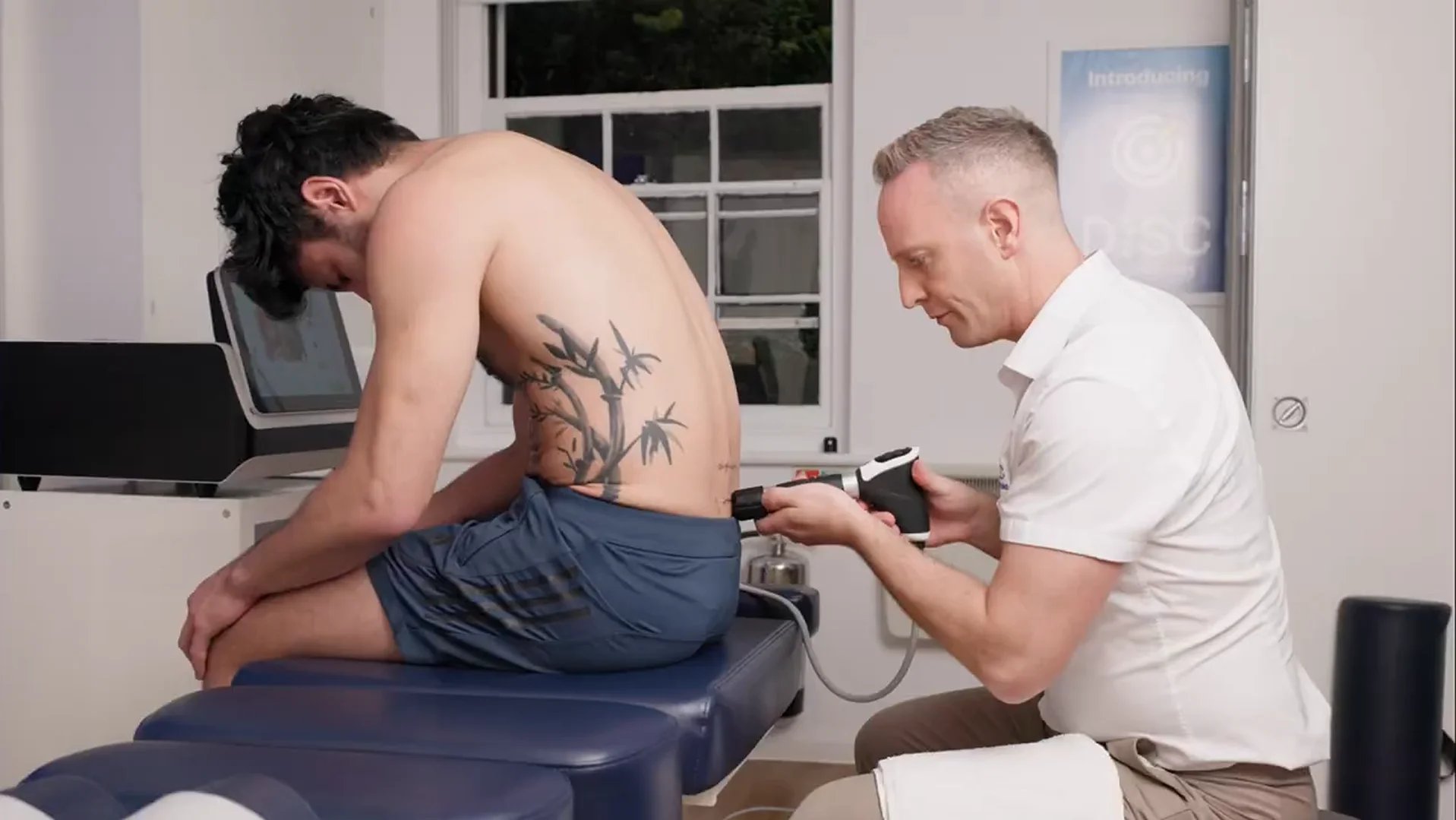
Spinal decompression is one of the technologies our clinic was built around, but its role in degenerative disc disease is different from its use with a slipped or herniated disc. Nothing is being pulled or pushed back into place.
For us, decompression provides a way to progressively unload and mobilise stiff or sensitive degenerative segments in a controlled, measurable way. This can be particularly useful when normal compression, standing or sustained loading repeatedly provokes symptoms and conventional manual treatment alone is not producing enough change.
Importantly, decompression is rarely the whole treatment. Within the DISC Protocol, it creates an opportunity to restore movement, address the structures around the degenerative segment and progressively rebuild the load tolerance that has been lost.
Our spinal decompression therapy page explains the technology and how we use it in more detail.
What treatments do you have for degenerative disc disease?
Not everyone with degenerative disc disease needs the full DISC Protocol, and we will say so at the assessment. We see plenty of patients whose scan looks alarming but whose spine still has good functional capacity and needs relatively little from us.
Mild degeneration with reasonable remaining capacity: If symptoms settle predictably and the spine still moves and tolerates normal life reasonably well, the answer may simply be better information, specific advice about loading and a short course of straightforward care. If that is your situation, we would rather tell you than book you into a programme.
Persistent or recurrent symptomatic degeneration: Repeated flare-ups, increasing irritability or a gradual loss of tolerance are different. Here the aim is to settle the sensitive segment, restore movement and better load sharing around it, then progressively rebuild what the spine can tolerate. Moving to the next stage before the previous one holds is one of the commonest reasons a reasonable treatment plan fails to last.
Treatment is selected around that process rather than applied as a standard package. Manual or instrument-assisted treatment may be used to restore movement, with gentler techniques where the spine is particularly irritable. Spinal decompression therapy can provide controlled unloading where compression consistently aggravates the segment, while Class IV laser may be used where pain and irritability are particularly slow to settle. Rehabilitation and graded loading then progressively return the patient to work rather than the treatment.
Chronic, complex or severe presentations: If the presentation is genuinely chronic, complex or severe, attributing the whole thing to the DDD visible on a scan contradicts the central argument of this page. The logical next step is reassessment and obtaining a differential diagnosis that explains the pain more accurately

Is surgery an option for degenerative disc disease?
Most degenerative disc disease is managed without injections or surgery.
The amount of degeneration on a scan does not decide treatment. What matters is the symptoms, loss of function, neurological involvement, whether the imaging matches the presentation, and the response to appropriate conservative care.
Medication or injections can have a role where pain is preventing progress, usually to create an opportunity to get moving and rehabilitating again.
Surgical opinion becomes appropriate where there is significant or progressive neurological loss, or where severe pain and loss of function have not responded to appropriate conservative care; in both cases, we are unlikely to still be calling the problem DDD.
What to do next
If a scan has told you that you have degenerative disc disease, the useful next step is working out how relevant that finding actually is.
That means understanding what the scan shows, whether the location and behaviour of your symptoms fit those findings, and whether anything else is contributing to the problem.
From there, treatment should match what is actually needed. Some people need reassurance and better advice about movement and loading. Others benefit from a short course of care or a more structured programme. If the presentation is more complex than the diagnosis suggests, the priority is establishing what has been missed before treating it as DDD.
The scan gives us part of the answer. The assessment decides what we do with it.